

Wombat Car Club was a small, community-focused car-sharing scheme serving Colchester and nearby parts of Essex and Suffolk.
Long before commercial car clubs expanded into the region, Wombat offered a simple, hyper-local way for residents to access a car without owning one. It operated for more than a decade, building a quiet but loyal following, before closing in the late 2010s.
A Local Car Club With A Personal Touch
Wombat Car Club began in the mid-2000s and was formally incorporated as Wombat Car Club Ltd in 2007. It was designed from the start as a neighbourhood service rather than a regional network. The fleet was small — just a handful of vehicles positioned around Colchester, Wivenhoe, Kesgrave and the surrounding area — and each car was given its own name, such as Ruby and Nessa. That personal, almost family-like approach to the fleet set Wombat apart from larger commercial clubs and reflected the scale of the operation.
The club followed a familiar back-to-bay, pay-as-you-go model: members booked a car for the time they needed, used it for local or occasional longer trips, and returned it to the same location. It was promoted as a cost-effective alternative to owning a first or second car, particularly for people who relied on a vehicle only occasionally, and priced at just £2.00 per hour plus 18p per mile, they weren’t wrong.
Partnerships In The Community
Wombat became part of several local sustainable-transport initiatives. One of the most notable was its partnership with the University of Essex, where a Wombat car was placed on the Colchester campus for students and staff. The arrangement featured in the university’s travel-plan work and formed part of a wider effort to reduce private car use.
The club also appeared in local transport and community documents in places like Wivenhoe, demonstrating how integrated it was with neighbourhood-level planning. At one stage, membership stood at just under 200 people — a scale that matched the size of the fleet and the club’s deliberately local focus.
A Hyper-Local Network
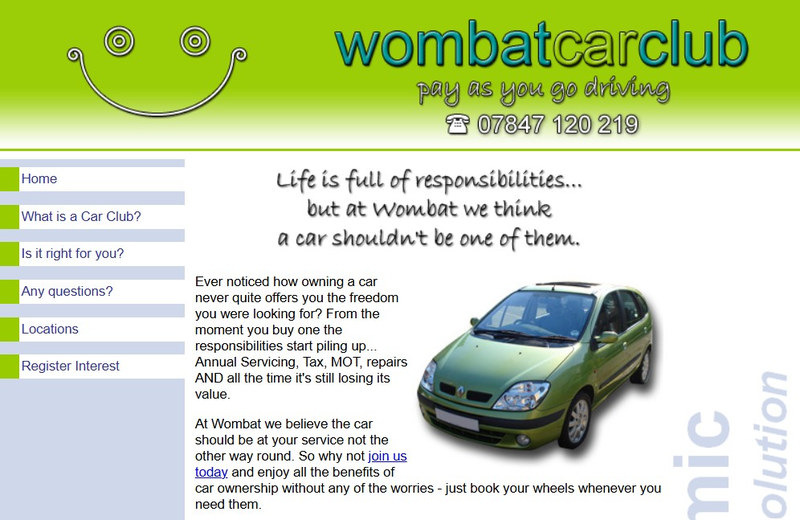
Wombat operated only within a narrow radius of Colchester. Cars were positioned in residential streets, near the university, and in nearby settlements such as Wivenhoe and Kesgrave. The service was designed to be walkable for most members; this was not a car club built around citywide or regional mobility but around day-to-day local journeys, short errands and occasional trips further afield.
This hyper-local identity was central to how the club worked. Members tended to recognise individual cars, and the club’s small size made it feel more like a community resource than a commercial product.
Closure And End Of Operations
Wombat ceased operations during the second half of the 2010s. The company behind the club was dissolved in 2017, bringing the scheme to an end after more than a decade in service. Its closure left a gap in Colchester’s transport options, and for several years there was no direct replacement until new car-club initiatives arrived in the early 2020s.
Wombat Car Club is remembered as one of the early examples of community-scale car sharing in the region — small, personal, and rooted directly in the neighbourhoods it served. Fleet sizes numbered in single digits, cars had names rather than ID numbers, and the service integrated naturally into local sustainable-travel projects.
Although it never sought to grow beyond its patch, Wombat played a meaningful role in introducing shared mobility to Colchester. Today’s services may be larger and more commercially structured, but Wombat’s legacy sits in the background: a reminder of how car sharing in the UK began at street level, long before the arrival of national operators.