

Co-Cars was a Devon-based shared mobility provider offering car-club vehicles, e-bikes and later cargo-bike deliveries.
It served Exeter, Plymouth and parts of the South West until it closed in 2023, ending almost two decades of activity under the Co-Cars name.
How Co-Cars Started
The story began in 2004, when a small car-club co-operative launched in Topsham and Exeter under the name The Car Club Co-Op. It offered a simple pay-by-the-hour model with shared cars positioned around the city.
In 2011, this original company was wound down and re-formed as Co-Cars Limited, a community benefit society designed to reinvest surpluses back into the service rather than pay dividends. From a member’s point of view, the shift marked a continuation rather than a reset.
Expansion Across Devon And The South West
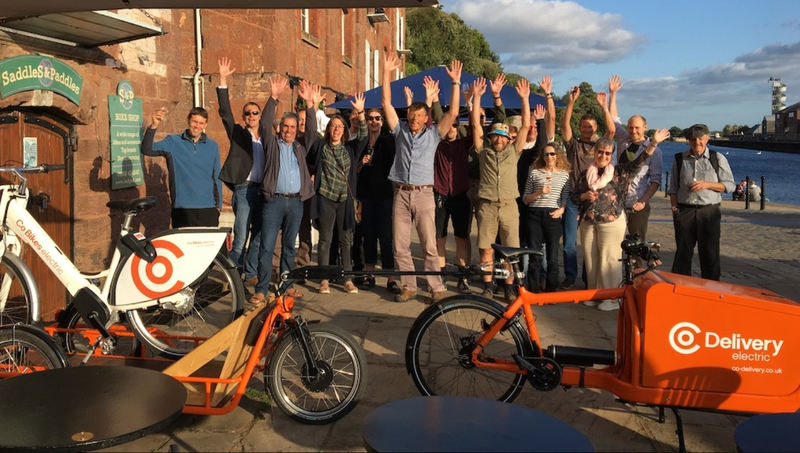
Over the next decade, Co-Cars grew steadily from a local operation into a small regional network. It added cars in Exeter, Plymouth, Truro, Falmouth and Salisbury, and by the early 2020s had around 2,500 members.
Its distinctive focus on low-emission transport shaped the brand, and its close partnerships with councils helped it secure charging bays, parking locations and long-term support. The organisation also picked up industry recognition for its contribution to sustainable travel.
One of Co-Cars’ defining features was its multi-modal approach. Alongside electric and low-emission cars, the company launched:
- Co-Bikes, an e-bike hire network with docking stations in Exeter and later Falmouth
- Co-Delivery, a cargo-bike service for last-mile logistics in Exeter
These additions made Co-Cars an early example of a blended shared-mobility operator in a regional setting.
Financial Pressures Begin To Build
Despite outward growth, the business model was fragile. Co-Cars relied on a mixture of member income, shareholder investment and public grants. Its accounts show rising turnover through the late 2010s, but profits were minimal and increasingly dependent on external funding. As the organisation expanded its team and added more sites, those costs became harder to cover.
The pandemic intensified the pressure. Lockdowns reduced demand for shared cars and e-bikes, supply-chain delays pushed up costs, and vandalism affected some bike infrastructure. Even after restrictions eased, changing commuting patterns and higher energy costs limited the recovery.
Co-Cars raised around £650,000 from shareholders in 2020 and continued to receive grants, but losses increased in both 2020–21 and 2021–22, even as turnover roughly doubled.
Administration And Closure

By mid-2023, the organisation could no longer meet its financial commitments. Administrators were appointed to seek a buyer for the car-club fleet, the e-bike network and the cargo-bike operation. No complete rescue deal emerged, and Co-Cars ceased trading on 14 July 2023.
The subsequent liquidation process revealed the scale of the collapse:
- Assets, including e-bikes and spare parts, were worth far less than their book value
- The company faced an estimated £1.3m shortfall to creditors and shareholders
- Thousands of members were left with unused credit or unexpired memberships
How Co-Cars Is Remembered
Co-Cars never became a national name, but as a local car club that was never the intention. It played a significant role in bringing shared mobility to Exeter and the wider region and it did so for a very long time. It showed how a community-rooted operator could combine car sharing, e-bikes and cargo-bike logistics long before these ideas entered the mainstream.
Its closure highlights the economic challenges faced by small, grant-supported transport providers — but it also marks the end of one of the South West’s most ambitious low-carbon mobility projects. Had it not been for the pandemic, Co Cars may well still be around today.